Sunday, July 31, 2016

Tomato patch update

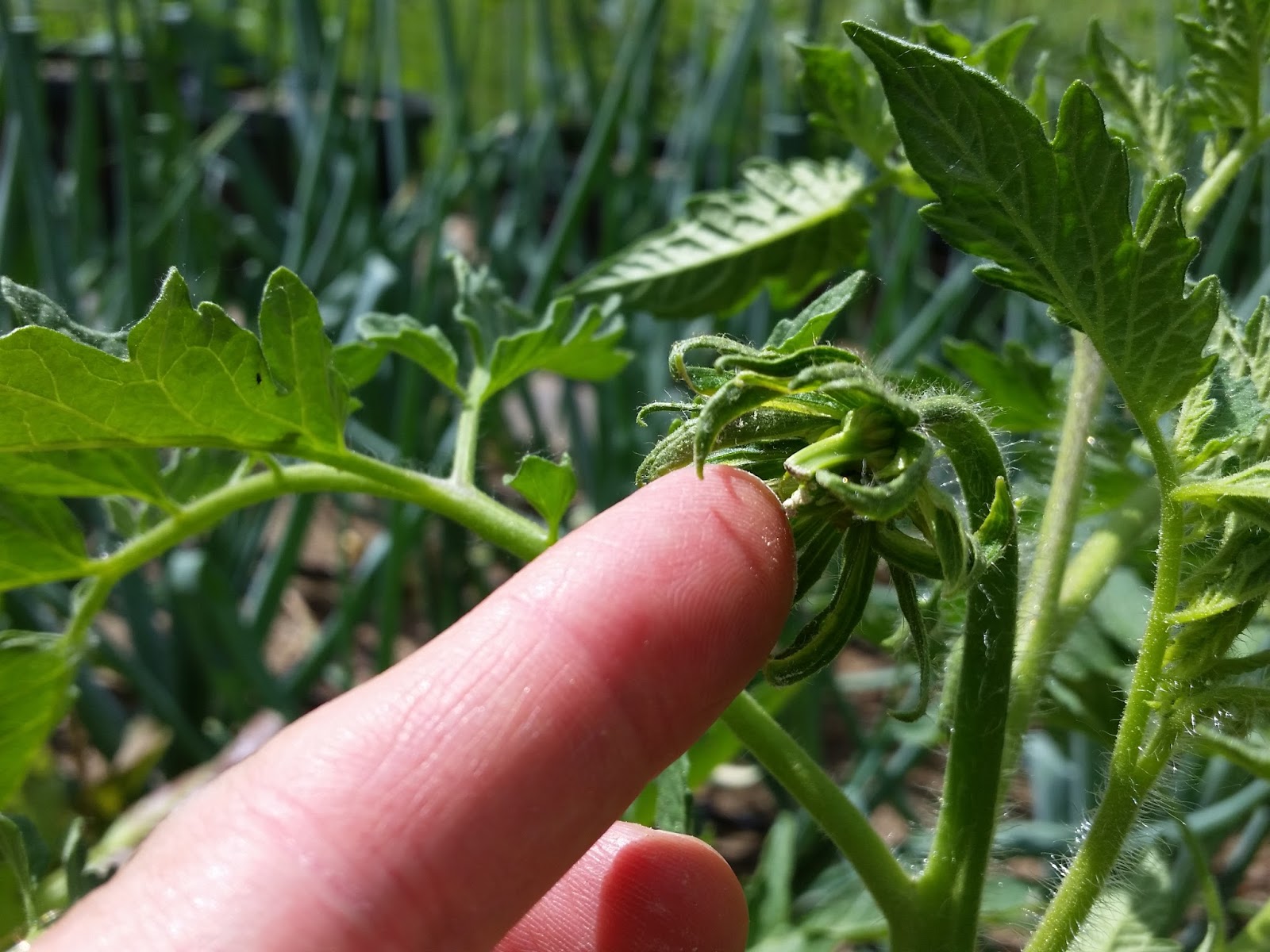
All my giant tomato plants now have 2 to 3 megablooms per plant with fruit set on them. The varieties that I'm growing (Domingo and Big Zac) are megabloom popping machines! I have lots of greenies like these. 12-14 sepals per bloom, and a stem like the base of a giant sequioa. Which do I keep?


In some cases, the megablooms with fruit are right at the top of the stakes, which will make it interesting trying to support them. I've got a plan. We'll see if it works!

All other things being equal, I would have thought that more sepals = more size, but some of the highest sepal counts have produced funky tomatoes, like this one, which I think had 18 sepals. The ones that look like this, where the skin splits and the guts start spilling out, haven't done that well for me in the past. This one looks like a green pregnant woman is trying to escape.

Back about a month ago, I posted this picture of the biggest megabloom I had ever seen (22 sepals).

I coated the stigma with a thick layer of pollen, and I thought I got it to take. Well, 1 month later, it's finally starting to grow! This one is just a mess of fused scar tissue, sepals, and lobes. I can't wait to see how it turns out!

This tomato, on the same plant as the previous one, looks more like what I want to see. 5 big, fat lobes, all growing very well. (Domingo, from last year's champ.)

Here's a Big Zac in a container. It's starting to show some color, so its days are numbered. It should go about 1.5 lbs. 18 sepals and only 1.5 lbs. I don't think I have the watering and feeding discipline to grow giants in containers.

Here's another Big Zac, that should be over 2 lbs.

The Hrenchir Big Zac is finally getting into the swing of things, with a nice 14-sepal 3-lobed 'mater.

The biggest tomato in my patch has suffered a huge setback. The plant has contracted some kind of disease, and it's dying. I cut the top 1/4 of the plant off, to get rid of leaves with black, mold-like leaves, and stems with necrotic tissue. The rest of the plant is wilting, even in the cool early morning hours. I don't think it's going to reach its full potential, but I think it will still be over 3 lbs. I've got triple layers of protection, to keep it safe from Ted's critters.

That's all for now. Hopefully, you've got your table set, because fruit set this week will ripen in late September, when cool nights and the threat of frost will make things more difficult.

Monday, July 18, 2016

Sling Shot

Before putting this baby in its stork bundle I made some measurements - 16.75" circumference. According to last year's curve fit, it should be at 1.8 lbs now. I suspect it's a little lighter than that, because it's a Domingo, which run light, and it has some gaps. But still, I'm glad it didn't peel itself off the vine before I got it in a hammock! I didn't keep good records of when I pollinated it, but I think it has ~3 weeks to go, so I expect it will be well over 2 lbs before it's done.


Somehow, the sling picture showed up in Chrome but not IE, so here's a repost.


Tuesday, July 12, 2016

Baby Pictures

Still just babies, but starting to put on some weight...

 Big Zac in  a container

Another Big Zac

Domingo from last year's 3.69#

Friday, July 1, 2016

Pollinated MB

I know you guys don't need any proof that my pollinating methods work, but here is some anyway.


The megabloom is the left-most tomato in this picture, but all the other blossoms have tomatoes set as well. I did the full pollination method on the megabloom, but the electric toothbrush on the others was enough to get them to set. Pretty much every megabloom in my garden now has a tomato started, which was not the case last year when I let nature take its course. The only one that hasn't set fruit is the Hrenchir Big Zac, which somehow couldn't finish the job. All of the plants from Johnston-grown tomatoes have large offspring on the way. Heh. Heh.

Thursday, June 30, 2016

Game Over

The Champ finally has a bloom.  Unfortunately it doesn't look like a Megabloom....IT LOOKS LIKE A GIGABLOOM!!!  Honestly, it could be a terabloom.  Unfortunately for the rest of you it also looks like GAME OVER.  Although a little disturbing, I am glad The Big Dog posted his artificial tomato insemination technique...I will probably get my wife to the dirty work for me.


Wednesday, June 29, 2016

Pollinating megablooms

Giant tomatoes start with giant fused blossoms, or "megablooms". But the biggest megabloom won't do you any good if it doesn't get properly pollinated. Tomato blossoms normally self-pollinate without difficulty, but for some reason, big megablooms need a little help setting fruit. This is probably the most important thing that I learned last year, so pay attention...

Keep your eye out for larger than normal blossoms. A simple count of the green petals or "sepals" will give you an idea of how big your blossom is. Normal blossoms have 8. Anything with 12 or more sepals is good. I think last year's winner had 12 or 14. This is the biggest megabloom I've ever seen at 22 sepals.


The best time of day for pollinating is supposedly 10-4, but I've been successful doing this in the evening after work. First, you need to gather pollen from as many blossoms as you can find. With a vibrating electric toothbrush, gently vibrate the blossoms and catch the pollen as it falls out. Some people recommend using a lens from an old pair of sunglasses, but I've found with even the slightest breeze, the pollen tends to blow away. So I prefer a dark bowl to catch the pollen.


BTW, one person on a tomato forum said she gets about 75% success rate just vibrating the blossoms with the toothbrush, and not doing any of the following steps. I've been regularly vibrating the blossoms on all my eating tomatoes, and I seem to have set a larger than normal amount of green tomatoes.

Once you've collected the pollen, you need to prepare the blossom for pollination. The blossom should be receptive to pollinating as soon as the yellow part opens up. Don't wait too long, because the window of opportunity for pollination is only a few days. After vibrating off any pollen from the male yellow part, you want to remove the yellow to provide easy access to the female tip, or stigma. I just pinch them with my fingers, and they peel right off.


The emasculated blossom will look something like this. On a normal blossom, there will be a single pistil, and the stigma will be just a dot in the middle. But on a really good megabloom, it will form a long ridge, and may have multiple ridges, like this one.


With your finger, wipe the pollen out of the bowl until your finger tip is all chalked up.


Then gently dab the pollen onto the stigma. You don't have to push. The tip should be sticky, and just a gentle touch should coat it with pollen. If you look closely, you can see that the ridged tip of this one has been dusted with pollen.


If you do this correctly and the pollination takes, you'll see the tomato start growing after a few days to a week or so. Here's a nice megabloom that I apparently pollinated correctly, because it's growing.


This one was on a Big Zac that I had slated for growing eating tomatoes. But dang, that tomato is looking so good, I may need to repurpose this plant! It's already as big as anything that Fred grew last year, and it's only a few days old.

Friday, June 17, 2016

More MBs

The megablooms keep coming! Check out this bad boy on a Big Zac. I thought I had a dandelion growing in my tomato patch. I count about 18 sepals, with a wide fused pistil in the middle.
 

And check out the thick stem feeding this sucker. You know it'll be capable of supporting a monster in a couple of months.

I went out yesterday armed with my electric toothbrush and did my best to pollinate this beast. I left it dusted like a powdered donut, so hopefully it takes. The problem is it's growing in a container, which historically has produced small tomatoes for me. I intended this plant to produce eating tomatoes, but I may have to repurpose it now.